Where Literacy and Technology Meet: A Shared Vision for Humanity
by Joanie Harmon
Maryanne Wolf and Ramesh Srinivasan are two globally renowned UCLA scholars who share a common mission. Their respective research goals embody the commitment of the UCLA School of Education and Information Studies to creating and sustaining access, equity, and justice in institutions that steward and provide knowledge. Wolf’s work focuses on the critical role of literacy in developing an empathetic and democratic society, while Srinivasan examines how to protect humanity from the potentially harmful impacts of artificial intelligence while harnessing its advantages for the good of all.
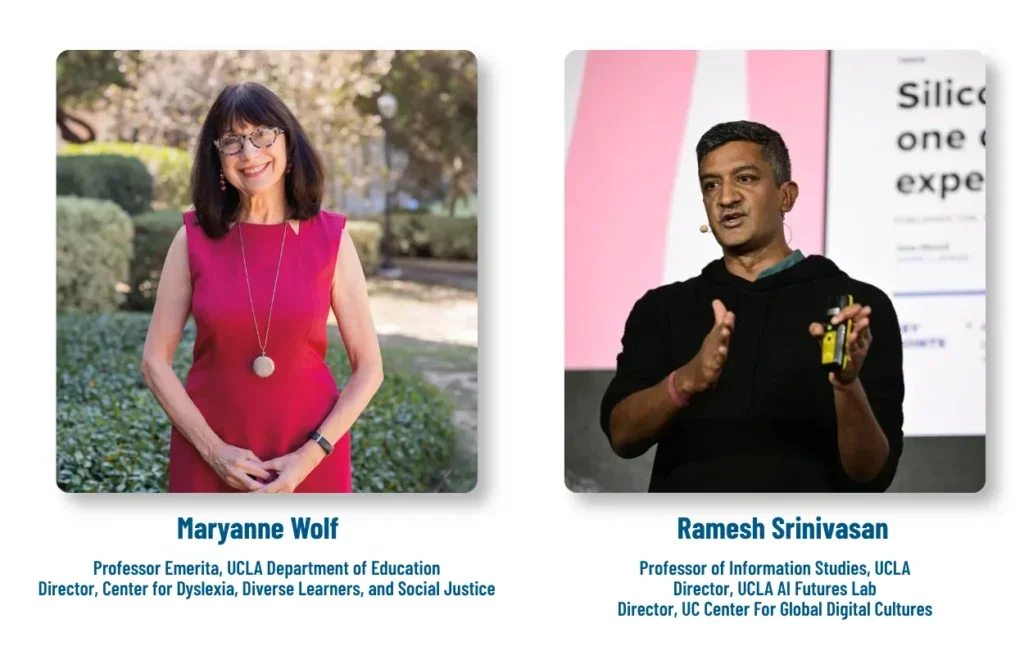
Together, their work underscores the importance of preserving the human capacity for critical thinking, empathy, and wisdom in an increasingly digital world.
Ed&IS: What is one of the most urgent impacts of digital technology on education?
Maryanne Wolf: H.G. Wells noted that human history is more and more “a race between education and catastrophe.” My work is to bolster the side of education in that race, particularly by increasing our knowledge about the impact on our young of digital exposure from infancy to young adulthood.
In my last book, I proposed what I call the biliterate brain as an example of a non-binary approach to the use of print and digital devices. It is an essential aspect of public education to understand the significance of changes to the language and attention networks in the young brain that are associated with the amount of digital exposure.
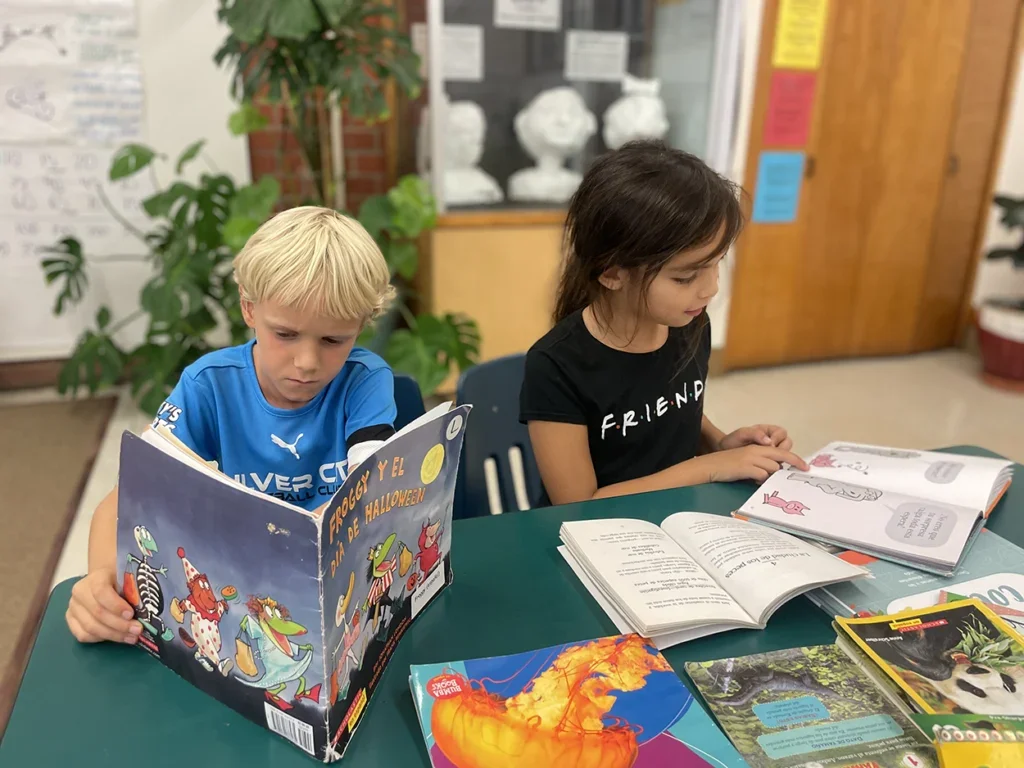
There is no end of statistics in the present moment that indicate the loss of deep reading literacy. The international Programme for International Student Assessment (PISA) score for 15-year-olds is declining demonstrably in the U.S. and across most countries with the notable exceptions of Korea, Japan, Singapore, and various regions in China. The national “report card” (NAEP) scores for 4th graders in the U.S. indicate the worst scores in literacy in two decades; 8th graders fare worse with the worst scores in four decades.
Let’s put this in the context of citizenship preparedness in a democracy. Only one-third of U.S. 15-year-olds are able to read proficiently while another third is not even reaching basic reading level. This is unconscionable. While some tech and national leaders protest that we have to advance with AI to “win the war” with China, we have already begun to lose a far worse war: the intellectual capacities of our young.
As Pope Francis emphasized before he died, the crisis in education can alert us to what we must do. Within that context, I am working on interventions and instruction for children that develop deep reading in print for the first 10-12 years and then teach the child how to use these deep reading processes, regardless of whatever medium has been innovated. We need digital wisdom and we need young citizens who can think critically and have an empathic understanding of other human beings. Both are essential for a democracy.
Ed&IS: How do these concerns about digital technology extend to college students and older users, particularly as artificial intelligence becomes increasingly prevalent?
Ramesh Srinivasan: AI could be a tool that augments, that expands our creativity, our capacities to do things, but instead, it’s being pushed on everybody as a replacement for us. I’m teaching the “AI and Justice” class, which is so popular with the undergrads – theirs is a heartfelt response and they care about it. There is an incredible amount of anxiety that all our students face but our undergraduates especially, because they are concerned that they are going to not have a job or economic security, since many of them also have some level of student debt.
Basically, I think we’re at this inflection point and it’s our job as educators to equip our students with as much literacy as possible, which is tough for technologies that are intentionally designed for illiteracy. They’re opaque, the models are not open source, the data it learns from is not being disclosed. We don’t have any literacy about what’s being gathered from us, and no one’s being paid for any of it. What we are trying to do is arm our students so they can understand how these technologies work, at least on a socio-technical level because on a very specific computational level, a lot of it is not disclosed.
I truly believe we can transform the direction our society, our economy, our political environment are having with technology if we remember that technology has long stood for one word that I think really sums it all up: tool.
We think about what a tool is; we know what it does and what it doesn’t do. You know how much it costs. You basically know what it needs to ‘work.’ But that is not what is happening now.
That is what is creating this mass anxiety and even the data center backlash. People are seeing data centers as tied to a set of forces that are shaping our lives in a sense of insecurity about the present and the future… that we feel powerless to address, and to some extent, incapable of even understanding. And I think that the incapability of understanding is directly tied to the ways these technologies are designed.
We could change all of this very easily, and what we would need to do is have transparency. People should know what’s being collected about them and the default should be not scraping and grabbing every single thing you can, about everybody.
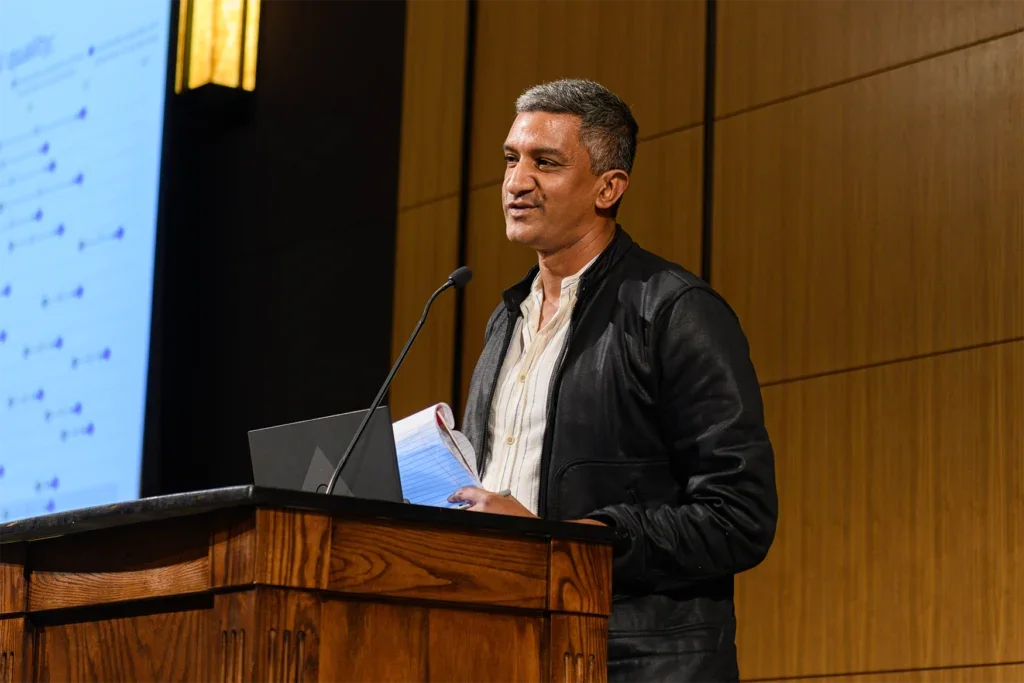
I also feel like people should be paid for their data, to the extent that the data is informing and creating value for these astronomically high and perhaps unrealistically valuated companies. There is some discussion of the net value of the industry being inflated to approximately $10 trillion dollars.
So, if this were a tool to support us all, the businesses and corporate platforms that have built technologies and systems that can work with our data should be compensated for it, but they shouldn’t be compensated in such a way where the rest of us feel like we’re going to be jobless, impoverished, economically insecure, manipulated by these technologies; maybe killed by, if it turns into the ‘Terminator’ or ‘Robocop.’ That is not an acceptable future. Instead, we can develop and design regulatory and economic models that balance human innovation with technical innovation.
Ed&IS: Your research approaches these challenges from different perspectives. Where do you see the strongest connections between your work?
Wolf: This is why we both tackle that kind of question in, if you will, two areas of stratification. We’re both interested in the species and that’s the question we share: What is the future of our species? We both say this is a battle for humanity; this is a battle for the species. My particular battle is for the mind of the young and that it develops, and Ramesh is involved in the battle for a society, for a democracy, for the planet.
There was a report from MIT recently, where they call the effects of AI a “cognitive surrender of our intellect.” I’ve been working on this for the last 20 years. We can’t farm out the very efforts and attention that will build the reading brain circuitry. The reading brain expands with use and the converse. The most sophisticated cognitive, social, emotional, and ethical processes that underlie our common humanity are in no small part the product of what and how we read and write. In our culture’s rapacious devotion to efficiency, we fail to develop the same sophisticated brain circuit that Geoffrey Hinton writes built our digital culture.
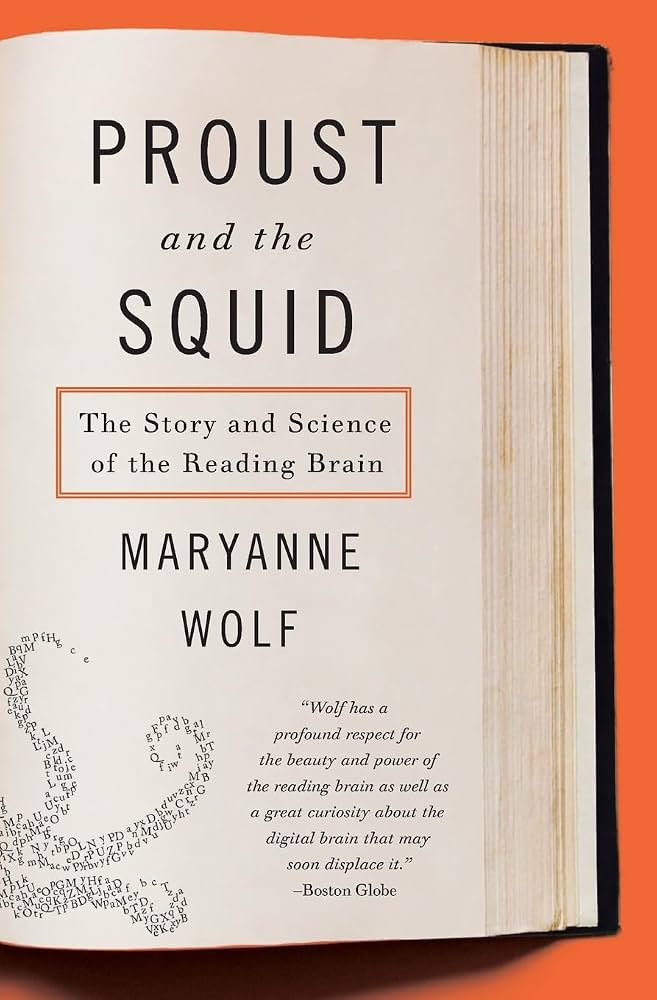
Whether we are focusing on the potential atrophy of the circuit in older readers or its formation in the young, we are becoming less and less able to evaluate the truth or validity of the input one receives, whether in reading or writing (a whole other topic!). At its simplest, we have begun short-circuiting the brain’s language and reading circuit. I was never prescient, but I first realized the warning signals 20 years ago in a book called “Proust and the Squid: The Story and Science of the Reading Brain.”
In 2018, I wrote about this in detail in “Reader, Come Home: The Reading Brain in a Digital World.” This year, Princeton University made this book the Princeton Pre-Read for all incoming undergraduate students to underscore the urgency in developing deep reading in every university student.
Whether we call it “cognitive surrender” or short-circuiting, we are changing the way humans think. What are the implications of these changes for human empathy and critical thinking? What Ramesh and I share is a mission for the preservation of humanity and the knowledge base we need to build about what processes and what practices compel it. Efforts at the level of the university like those in Princeton University highlight the importance of giving time, attention, and effort when we read and write.
In Italy, there is a movement for university faculty called “the University Without Books,” to underscore the often-misunderstood importance of long form books, not summaries, but texts that challenge and build cognitive stamina and what I refer to as “cognitive patience.” Our students need to see this as an act of resistance against the hijacking of their minds in the service of efficiency. I am working at the start of the process with the hope that our young can develop habits of mind that will serve them their whole lives. Educating them and their teachers to the importance of deep reading and writing is my response to H.G. Wells. As philosopher Martha Nussbaum wrote, “It would be catastrophic to become a nation of technically competent people who have lost the ability to think critically, to examine themselves, and to respect the humanity and diversity of others.”
Srinivasan: The stuff we’ve worked on as scholars for many years has now become a critical issue in the public sphere on every single level. The future of what life will look like is directly tied to our work.
I’m interested in what we do to actually develop literacy, so we understand how these technologies function. We shift governance so that in the hands of the right stewards of society in different facets, we can deploy these technologies to serve of course, some business benefit, but not in a way that’s an absolute zero-sum. Right now, quite honestly, as we take AI further and outside of the “Terminator” and “Matrix” kinds of dystopian swarm AI scenarios, we are heading more and more in a feudal economic direction.
I’m from Silicon Valley. I built this kind of stuff. Some of the people in this current administration were my roommates in college, so I saw the seeds of this kind of anti-human viewpoint, even in college. I didn’t think it would be this bad, but we are seeing fascist-type ideas of life influencing the deployment of technology.
As scholars who care about these issues, we’re not just studying it for the sake of studying it. We’re trying to push the public toward awareness and recognition that these technologies are being foisted upon people without consent, using their data and the surveillance of their data without appropriate disclosure or compensation.
What we have are technologists and engineers who are taking on the mantle of “designing for society” – now they don’t even say that anymore. They don’t have that deep social understanding, and in many cases, we’re talking about people in these AI companies who just want this all to be a black box that orders our world.
Ed&IS: Both of you have emphasized the importance of human wisdom in shaping the future of technology. What does that mean for the work ahead?
Wolf: I will underscore this with a quote from T.S. Eliot. “Where is the wisdom we have lost in knowledge? Where is the knowledge we have lost in information?”
Ramesh and I are in the pursuit of changing information into knowledge, and knowledge into wisdom. There are few greater needs this moment in our world than the search for our collective wisdom.

Srinivasan: I’ve been nerding out on Carl Sagan, and in the 1970s with the Voyager spacecraft, they sent gold records out to space, [with] every language and thousands of pictures. That was Carl Sagan’s attempt, along with NASA to say, hey, human beings, what are our legacies that we want to share with potential extraterrestrial civilizations?
I think it’s time to think about what our legacy and meaning is as human beings. Something that Sagan said at that time is that he was extremely concerned about the gap between advancing technology and wisdom and that human wisdom might be lagging far behind the so-called advancements made with technology. And I think that, more than ever, is what rings true. I don’t think it’s our fault we don’t have that wisdom because these technologies are completely opaque. But I do believe in the project of advancing human wisdom so that technology is to serve the purposes of humanity and our planet.
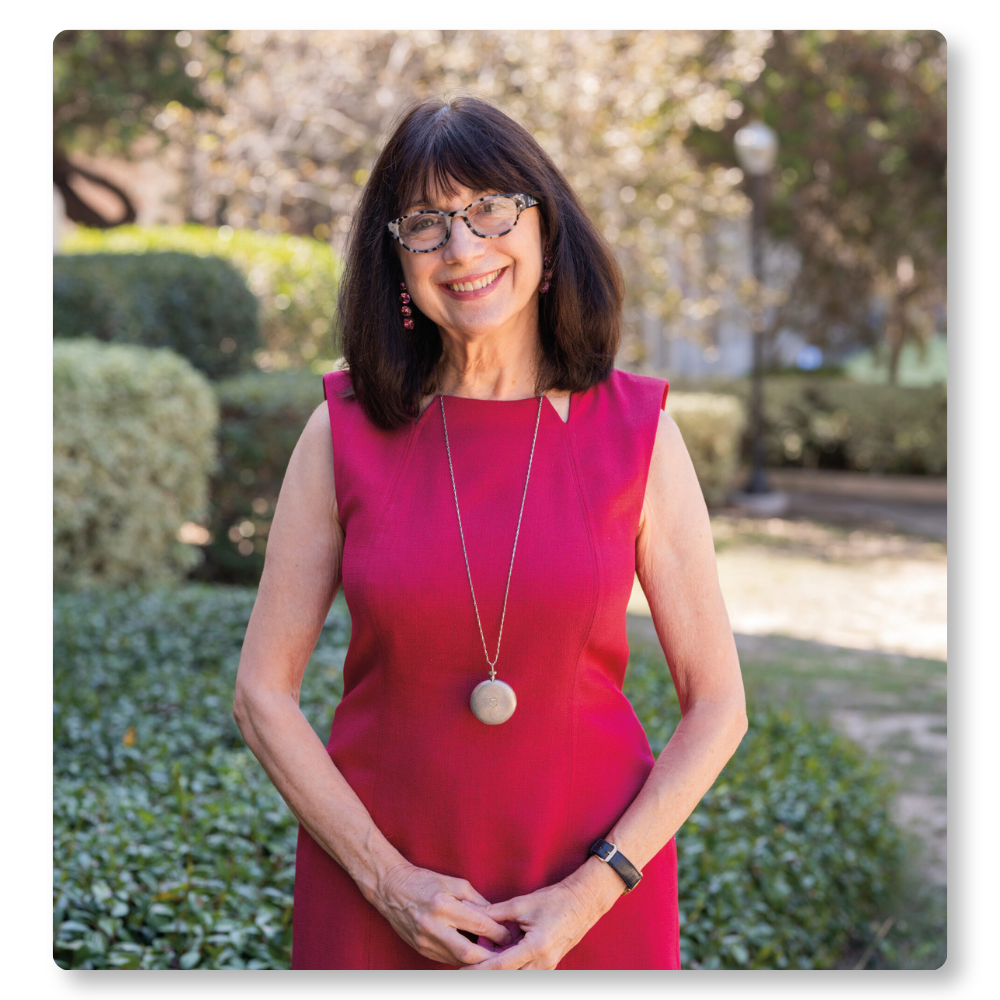
Maryanne Wolf is professor emerita at the UCLA School of Education and Information Studies and director of the UCLA Center for Dyslexia, Diverse Learners, and Social Justice. Her work delineates for educators, policymakers, and the public the changes in the reading brain in an AI-dominated culture and how ever-increasing dependence on digital technologies impacts human capacity for critical thinking, empathy, and reflection.
Professor Wolf is the author of “Proust and the Squid: The Story and Science of the Reading Brain,” which has been recognized as an Acclaimed Book of the Year by U.S. News and World Report and with the Marek Award from the New York International Dyslexia Association for the best book of the year on reading. Her most recent book, “Reader, Come Home: The Reading Brain in a Digital World,” was selected by Christopher L. Eisgruber, the president of Princeton University, as this year’s “Princeton Pre-Read” for 1,000 incoming students.
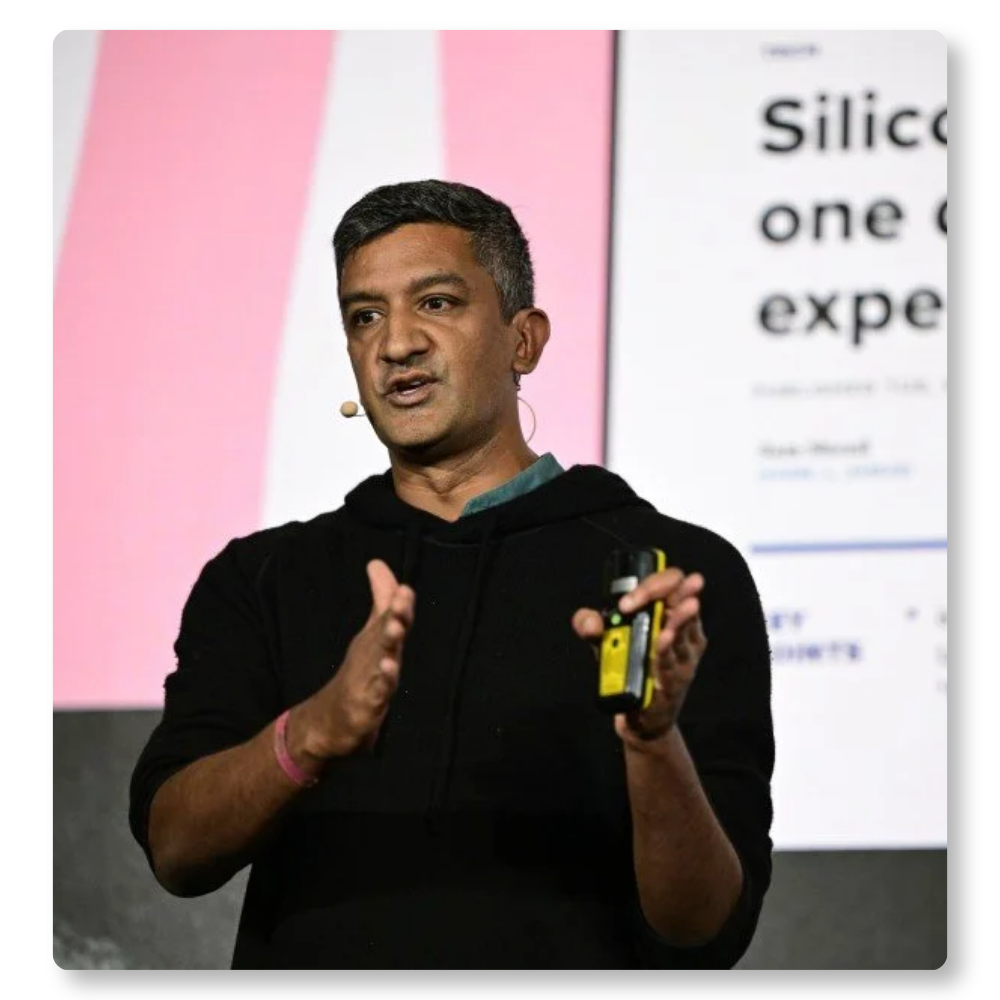
Ramesh Srinivasan is a UCLA professor of information studies and design/media arts, founder of the UC-wide Digital Cultures Lab and assistant director of UCLA’s DataX Initiative. His work centers on a people-focused analysis of new technologies working across the world, aimed at creating opportunities for all users of digital technology and a digital “bill of rights” that can right the balance between free speech and algorithms that spread misinformation and hate speech in viral proportions. Srinivasan currently works on data center policy with Congressman Ro Khanna.
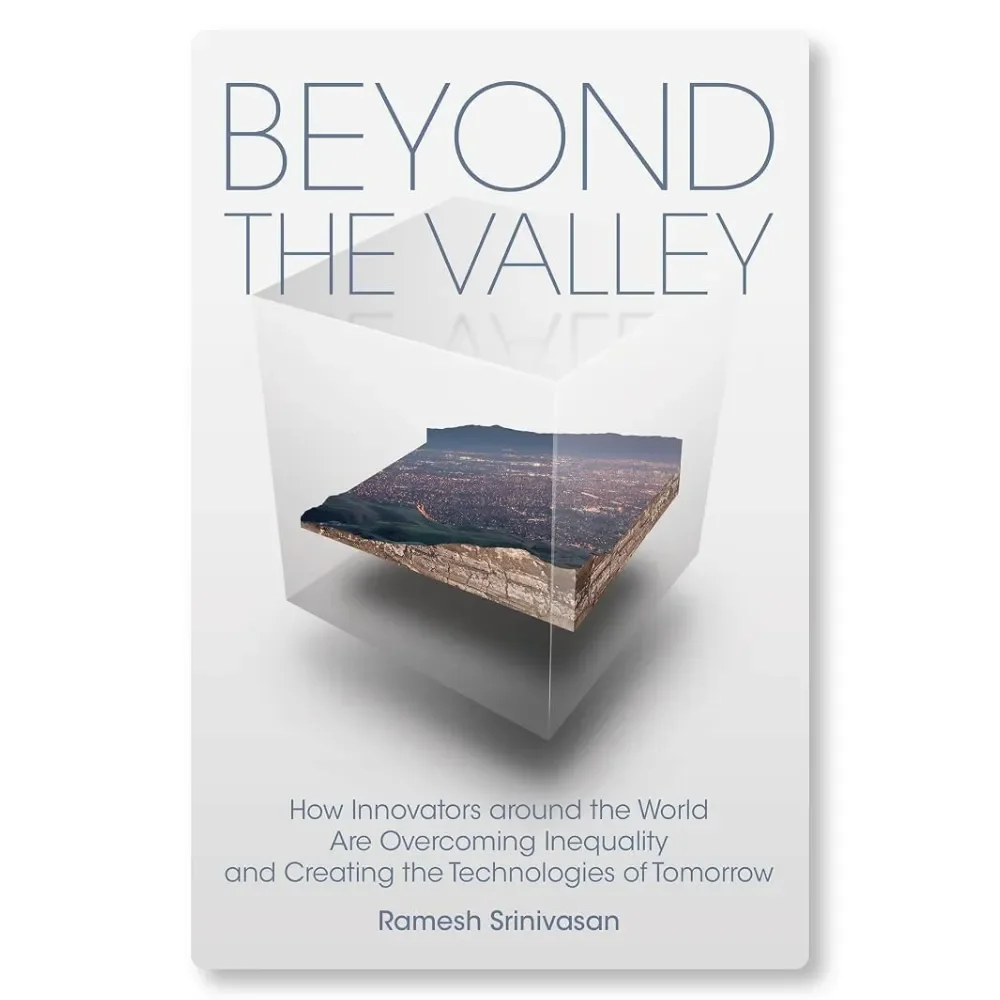
In collaboration with UCLA colleagues across campus, Professor Srinivasan is working to establish the AI Futures Lab, uniting the shared interest in artificial intelligence across disciplines and departments at the University. He is the author of “Beyond the Valley: How Innovators Around the World Are Overcoming Inequality and Creating the Technologies of Tomorrow,” which was named a Top Ten 2019 Book in Tech by Forbes, and of “Whose Global Village? Rethinking How Technology Shapes Our World.” Srinivasan is also the co-author of “After the Internet” (with Adam Fish).