Growing Their Own: New Research Explores Rural Teacher Residencies
by John McDonald
The Round Valley School District sits in the far reaches of Mendocino County, near the Round Valley Indian Reservation and the small town of Covelo. The district is about 140 miles and a two-and-a-half-hour drive from the closest public university, Sonoma State. The Round Valley School serves about 450 students, more than half of them Native American. Among the school district’s challenges, like many districts across the state, they need teachers. So, they decided to grow their own.
To do that, the district, in partnership with California State University Sonoma, established the Na-nak-lamek “Learning in Process Now” Round Valley Teacher Residency Program. Through an intensive, one-year program pathway, they are working to develop their own teacher–educators who know the culture, the people, and the land, and can help to preserve the Northern California Yuki and Wailaki languages.

Given their location and needs, the teachers who teach there need to learn and live there. To meet that challenge, the partners established a dedicated classroom in Covelo to support learning for residents from the community who want to become a teacher. Sonoma State University also worked with a high school in Ukiah to arrange access to on-campus bungalows, and one Saturday a month, university professors go there to offer courses for both undergraduate education and teacher credentialing.
The school district also found a grant to offer transportation. Some of the students have families and need someone to care for their children while they are away, so the partners also worked together to arrange childcare for the children of the students. And now, one Saturday a month, the students all go on a bus together to take the university courses they need to become teachers.
“As we built our teacher residency, I continually asked myself, ‘What would have helped me the most on my journey to becoming an educator in a rural community?’” says Joe Dukepoo, who is the principal of the Round Valley Elementary/Middle School, a descendant of the Round Valley Indian Tribes and a parent and lifelong member of the local community. “That question has guided every decision we made. By braiding together partnerships and resources, we have created a pathway that removes many of the traditional barriers to becoming a teacher. I am hopeful for the future of our district, our tribes, and our community because the next generation of educators will be our own people who are committed to serving the place they call home.”
The Round Valley School is a very long way away from UCLA, but their efforts are of great interest to the UCLA Teacher Education Program (TEP) and others. For more than 30 years, the TEP has helped aspiring educators to develop and sustain the knowledge, skills and understanding needed to help students succeed in schools in the urban core of Los Angeles. In the face of ongoing teacher shortages across California, the TEP has increasingly engaged in the development of teacher residency programs to recruit, prepare and retain teachers. The Teacher Residency Grant Program (TRGP), awarded through the California Commission on Teacher Credentialing (CTC), supports a full-year clinical experience alongside an experienced mentor, credentialing coursework, and a stipend ranging from $20,000 to $40,000. The program aims to prepare well-supported teachers, diversify the profession, and increase retention.
Drawing on its experience, UCLA TEP has joined California’s Statewide Residency Technical Assistance Center’s (SRTAC) efforts to promote the development and sustainability of teacher preparation through teaching residency models throughout the state. Teaching residency programs are most prevalent in urban settings, but urban schools are not the only schools confronting a shortage of teachers. California has almost 600 school districts with schools in rural areas or towns distant from urban areas. Research has shown the shortage of teachers is particularly acute in these areas. There is a significant need to understand the promise and potential of teaching residencies like the one in Round Valley and other rural areas.
To meet that need, researchers affiliated with the TEP and SRTAC have published a new research brief, “From Vision to Practice: Strengthening California’s Rural Teacher Residencies Through SRTAC Support.” The brief identifies the challenges facing rural schools in teacher development and retention and highlights the innovation and promise of rural teacher residencies as models of teacher preparation that build on and celebrate community strengths.
“The goal of the brief is to better understand the inequities and the assets, strengths, and tenacity of schools and communities in rural California,” says Emma Hipólito, director of UCLA’s TEP and a co-author of the report. “We want to shine a light on the implications for rural teaching residency pathways.” Importantly, in the process the researchers found ideas and innovations that can inform and inspire approaches to teacher development in other hard-to-staff contexts, including urban school districts.
“There is a real richness to our rural communities and much to be learned from working together with them, says Imelda Nava-Landeros, a faculty advisor at the UCLA TEP and lead author of the research brief. “Rural and urban spaces are more alike than we think. There is a lot of symmetry. We both need teachers.”
The research brief highlights the challenges confronting rural school districts, including vast service areas–teacher education deserts–that lack access to higher education institutions. Physical distance and transportation costs also pose challenges to program participation, as does limited broadband access. Many rural students face limited options for accessing public universities.
“The lack of statewide access to teacher education is truly an equity issue,” says Nava-Landeros. “People told me they often only have access to private online education, and sometimes for-profit, private online education. Many do not complete it and end up with even more debt.”

Rural residency programs offer a more sustainable path to the completion of teacher education through yearlong student-teaching designed around district needs. Residencies enhance access and participation for local candidates, many of whom are deeply rooted in their communities.
Amid challenges, the research found insightful and innovative local approaches to supporting and preparing rural teaching residencies. Collaboration is key. Consortia of small districts are joining together to build and pool capacity, share mentors, rotate teaching residents, and deliver enriched instruction across multiple sites, while working together to let programs adapt to local needs quickly. Drawing on the strengths of their communities, they are fueling “grow-your-own” efforts to develop and retain local teachers. Schools in rural areas are drawing on what some describe as “rural cultural wealth,” a recognition of the strengths, relationships, and adaptive practices embedded in rural communities that residencies intentionally recognize, value, and leverage to prepare, support, and retain educators.
“Leaning on local expertise and support, they have developed ways to think about credentialing and supporting teachers within multiple pathways to fit individualized needs,” says Nava-Landeros. “They are really trying to grow their own teachers. Rural districts have the challenge of attracting potential teachers from outside of their area. People who are not from the community or inadequately prepared through intern pathways often leave. They would rather invest in someone who knows the community, who has been there for many years, someone who is part of the community.”
The innovation can be seen in who the districts are recruiting as teaching candidates, targeting paraprofessionals already working at school sites or school parents and local community members who are close to or may already have an undergraduate degree. Local education agencies are recruiting retired educators and contracting with out-of-the-classroom educators to recruit and place mentors, sometimes sharing mentors across districts to support multiple teaching residents. Programs are intentionally designed with culturally responsive pathways, especially in bilingual and Indigenous communities.
Flexibility is essential. Programs are structured to meet the realities of the lives of teaching residents, offering evening classes, hybrid models, and online coursework. Partnerships have been established with county offices of education and community colleges to support educational initiatives. Community colleges and local high schools served as sites for credentialing coursework, often acting as satellite campuses. As one local education leader noted, “We built a pop-up classroom in a portable behind a high school, so folks didn’t have to drive 70 miles for class.”
“There are real challenges to rural teaching residencies, but I think the real beauty has been people pulling together and being very resourceful with what they have,” says Nava-Landeros.
Financial support for local teaching candidates and program sustainability is critical.
“The residency funding of at least the $20,000 required by a residency grant to go to students as a stipend is making a world of difference,” says Nava-Landeros. “It is allowing them to pay for tuition to attend university. Given what was communicated by residency program leaders, rural residency alumni, and our urban students as well, they wouldn’t have been able to pursue their credential because of too much student debt. They cannot not incur anymore.”
Funding also needs to account for additional costs of rural residencies, such as increased coordination, administrative expenses, and communication with potential partners. Local education agencies can also consider reallocating funding sources such Title I or Title II, or LCAP or intern pathway funds to support program elements such as living stipends and mentor compensation.
The SRTAC has played a vital role in supporting teaching residencies in rural areas, providing practical tools such as customizable slide decks to guide training efforts and sample memorandum of understanding templates. SRTAC staff also provide for partnership agreements and are also working to develop consortia agreements, as well as provide opportunities to share best practices, discuss challenges, and offer a network of peer support, and support services, including grant writing and sustainability planning. SRTAC’s Rural Residency Network provides ongoing support of rural local education agencies and their partners in institutes of higher education.
The SRTAC effort is not without challenges. The physical distance between locations, varied local conditions and complex responsibilities of local leaders can diminish awareness of available support. The research brief’s authors suggest a comprehensive guide on consortia building, offering various approaches, suggestions, and examples for forming consortia in rural districts, would be highly beneficial. Additional funding if needed to support opportunities for collaboration in-person and virtually, including funding a fulltime employee at local education agencies or Institutes of higher education to support the teacher residency program infrastructure in rural communities is needed.
Importantly, the authors note that the 2026-2027 California budget adds $250 million in additional funding for teacher residency programs in the state, increasing the grants for institutions providing teacher residency programs from $250,000 to $300,000 and expanding flexibility for program participants. Priorities target high need fields including support for hard-to-staff or rural education environments that are confronting acute teacher shortages. The new budget also provides $30 million to support the work of the SRTAC.
Institutes of higher education play critical roles in support of rural teaching residencies but are also confronted by significant challenges. Among them, UCLA and others are not tailored to serve students in rural areas. Admissions practices, attendance and pedagogical approaches requiring in-person attendance may dissuade or prevent participation. Physical distance is a barrier creating teacher education deserts, and it can breed a lack of trust by rural communities of institutes of higher education. In addition, program curriculum often does not reflect local contexts and needs.
Teaching candidates and residency leadership and staff in rural areas are also challenged by costs of travel to institutes of higher education and satellite locations, and funding is needed for childcare and other support services. Residents also need support in applying and enrolling in programs, and meaningful support while in the program.
“One of the challenges we face is in finding ways to bring elements of the university to teaching residences in rural settings and finding ways to make It work for both,” says Nava-Landeros. “The work requires innovation, collaboration and a change in practices. It’s going to take some shifts in mindsets that allow us to open up to the possibility of saying ‘yes, this can be done.’”
To better support teaching residents in rural areas, the research brief suggests institutes of higher education make changes to expand program access to a broader range of teaching candidates across geographically widespread and sparsely populated districts and establish satellite instructional hubs at local high schools or community colleges to reduce travel burdens and increase participation. Hybrid online and in-person coursework structures and intensive summer sessions can also offer flexibility and increase participation and engagement.
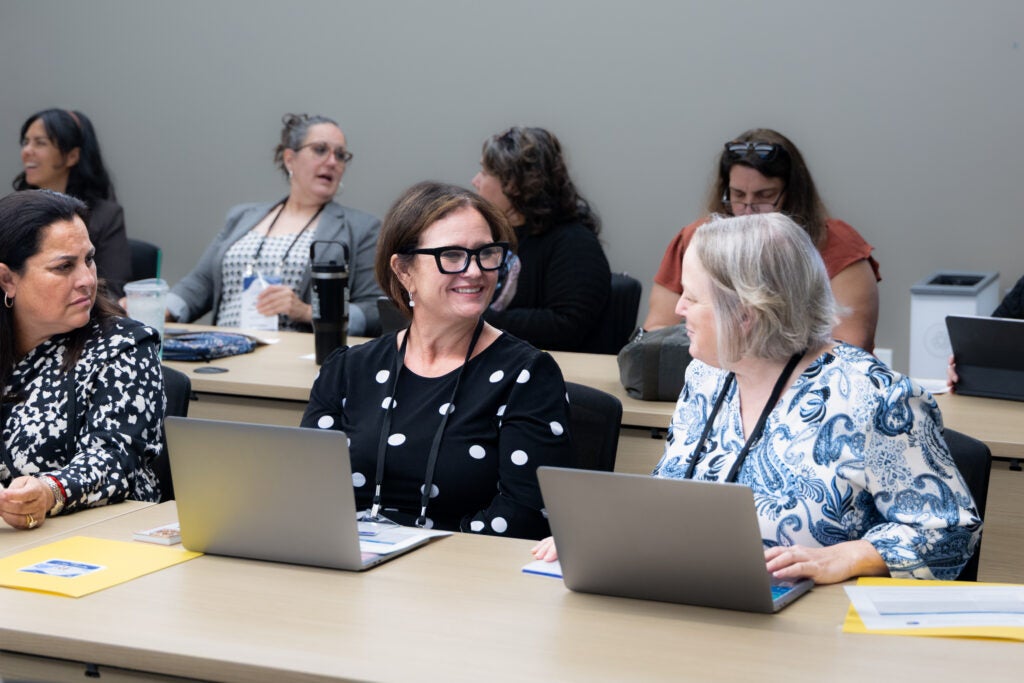
To achieve lasting impact, the authors contend that systemic structures and dedicated legislative funding are essential to ensure the permanent and sustainable implementation of teacher residency models, particularly in rural communities. Technical assistance centers, such as SRTAC, must continue to address rural-specific needs, build local capacity, and connect regions through shared tools and learning communities.
Institutes of higher education also have a larger role to play. Teacher education programs need to place a priority on building and sustaining relationships by meeting district and community partners in their own local contexts and intentionally adapting curriculum to reflect the rural communities they serve.
“There are shifts that institutes of higher education can consider in accommodating and meeting the need of rural spaces,” says Nava-Landeros. “One is getting to know them. Being there, reaching out, going physically to those spaces, is core to building relationships. Zoom is great, but it’s not the same connection. When you go there in person they so much respect that you made the trip. Sitting down, having some coffee, breaking bread together goes a long way. And we need to do a lot of listening and learning.
“One of the things we have learned is that most of our districts in the state are in rural settings. As public institutions, we need to think about what we are doing to better serve all of our state,” she concludes. “I’m hopeful that by going into spaces where maybe we traditionally haven’t gone, we can begin to build better bridges across our state. We all want the best for our students.”
The research brief, “From Vision to Practice: Strengthening California’s Rural Teacher Residencies Through SRTAC Support,” is co-authored by Imelda Nava-Landeros and Emma Hipólito of the UCLA Teacher Education Program and Sheila Rocker Heppe of SRTAC. The full research brief is available online here.