“How Schools Make Race: Teaching Latinx Racialization in America”
Q&A with Laura Chávez-Moreno and Book Excerpt
by Joanie Harmon
“How Schools Make Race: Teaching Latinx Racialization in America,” by Laura Chávez-Moreno, takes an unflinching look at how policies, pedagogy, and raciolinguistic ideologies interact—often unintentionally—to produce, reinforce, and sometimes blur racial boundaries. The book also illustrates the contradictions that emerge even within schools and communities committed to anti-racism.
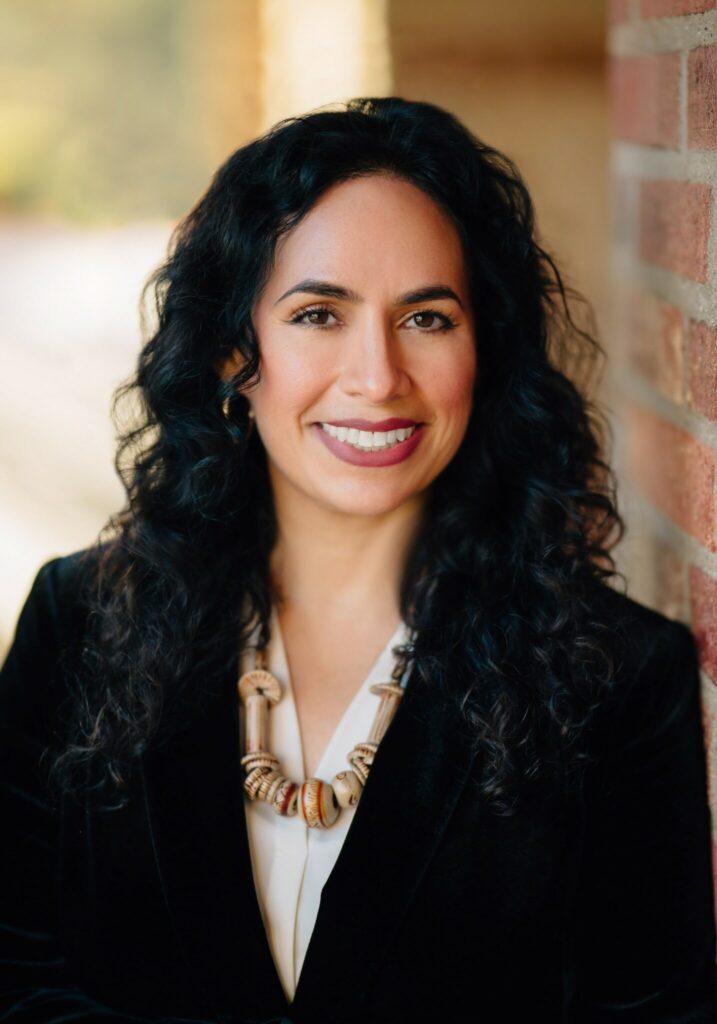
An associate professor in the UCLA Department of Education and the UCLA Department of Chicana/o & Central American Studies, Chávez-Moreno draws upon her ethnographic research in a Spanish-English bilingual education program to rethink race, to reconceptualize Latinx as a racialized group, and to pay attention to how schools construct Latinidad (a concept about Latinx experience and identity) in relation to Blackness, Indigeneity, Asianness, and whiteness.
In “How Schools Make Race,” Chávez-Moreno also highlights how schools can offer ambitious teachings to raise students’ critical consciousness about race and racialization, providing essential lessons and tools for educators, policymakers, and anyone seeking to understand how race is made, maintained, and challenged in everyday institutional life.
Chávez-Moreno achieved her PhD in curriculum and instruction from the University of Wisconsin-Madison School of Education. Her research has been published in the Review of Educational Research, Educational Researcher (2022, 2025), American Educational Research Journal, and Journal of Teacher Education (2015, 2021). The National Council for Teachers of English (NCTE) awarded the 2023 Alan C. Purves Award to her article, “The continuum of racial literacies: Teacher practices countering whitestream bilingual education,” published in Research in the Teaching of English.
Ed&IS: What do you hope “How Schools Make Race” makes evident about the role of bilingual education?
Laura Chávez-Moreno: The book shows that bilingual education and education more generally—is a racial project. It shows what that means and how it functions in contemporary schooling. I hope the book makes clear that we have influence over what that role is.
There are several ways that bilingual education functions as a racial project in the U.S. One is in combating racism, such as anti-Latinx racism; monolingual schooling; schooling that’s not culturally relevant, etc. In this way, bilingual education is a racial project that is anti-racist and works towards remediating historical and structural discrimination.
Another way that bilingual education functions as a racial project is in maintaining racist practices, such as tracking and testing, that end up offering Latinx students substandard curriculum and instruction. Because Latinxs were tracked by language, a lot of Latinx students received curriculum that was reading a text and answering multiple choice questions. Yet the program offered its upper-track classes more enriched and research-supported activities, such as choosing a book to read with friends. The different types of experiences lead to different outcomes and those different outcomes—repeated over and over again—create patterns that then we recognize as, ‘Oh, there’s this one group, and then they do well in school, and then there’s this other group, and they don’t do as well in school.’ These practices reinforce the idea, again, that there are racial groups, and that some are better than others, as if it were an innate instead of recognizing that our social practices create race and racial differences. Without recognizing this, Latinx and other students can think that whatever it is that they’re achieving or not achieving is due to them. It’s very important to interrupt that thinking, to understand that the racial patterns we notice are caused by social practices that we can change.
Bilingual education is also a racial project through not challenging hegemonic ideas about race. In lumping students together and offering opportunities based on Latinxs’ Spanish language, it reinforces the Latinx racial category as being delineated by an imagined Spanish. I say “imagined” because not all Latinxs speak Spanish, but racialized groups need markers that delineate and differentiate it from other groups, and these have to be reinforced in society every day. I argue that the program contributed to making Spanish that boundary for the Latinx group. Through our institutions—for example, schools—we keep reinforcing the ideas of race and groups, and their boundaries and differences. So, how the bilingual program associated Latinxs with Spanish and structured its opportunities (and taught about Latinidad, which I didn’t get into here) it kept reinforcing those ideas.
Ed&IS: What surprised you about your study?
Chávez-Moreno: I started the study with a broad question of how the bilingual education program was serving its Latinx students. But I was open to noticing different things that happened in the field, because there wasn’t much research in secondary-level dual-language programs.
And then I started hearing, both in the bilingual program and also in the media outside of school, that people were saying that Latinx was not a race, that it was an ethnicity, which I thought was interesting. I grew up on the Mexican-U.S. border, and I thought that it was a race. So then when I started hearing that it wasn’t, that it was an ethnicity, I started thinking, “well, maybe I’m wrong—maybe it is not a race, maybe it is an ethnicity, or maybe it’s something different.” That then led me to thinking, “well, if it’s not a race, then, what is race?” A lot of scholars say that race isn’t skin color or appearance, but that’s how people were thinking of race and consequently that Latinx is not a race.
Once I finished collecting the data from the schools, I started reading different areas of scholarship, like philosophy of race, history, ethnic studies, and sociology, to understand what is race and how different fields thought about it. That led me eventually to thinking differently and shifting the question from what is race to thinking about the process, that is, how race is made. Seeing what my initial question evolved to was kind of a surprising thing, because that was not something that I was expecting to even think about.
Ed&IS: How do you hope educators will use the book?
Chávez-Moreno: I hope that teachers and other practitioners find the book helps to deepen ideas about race and how to teach about it to adolescents who already know race and racism exist. Many of the teachers in this book were teachers who I wish I had when I was a student. They were committed to having their students understand that race does affect people’s lives and that racism exists, lessons that I didn’t have in my schooling.
I wrote this book for those educators, for those who are interested in having conversations about race that push the boundaries of common understandings. The book shows how race is a social construction—a phrase we hear repeatedly. However, the phrase becomes perfunctory if we’re not teaching that racist practices are what make race in society. For educators who want to think and teach about this, I’d also recommend my article with Celia Lacayo in Race Ethnicity & Education, which presents these ideas in a conversation.
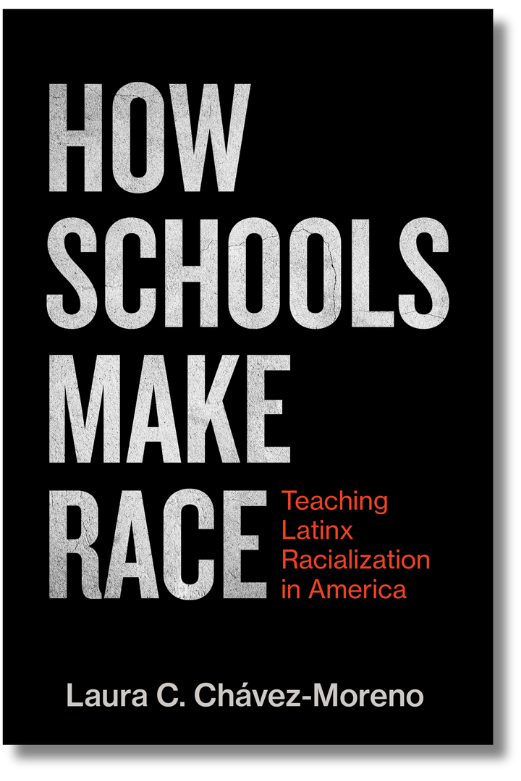
EXCERPT from the Preface of ““How Schools Make Race: Teaching Latinx Racialization in America”
Preface
On Friday, June 16, 2017, Amlie High School held its graduation ceremony. I had attended other high school graduations, including my own in Douglas, Arizona, a town bordering México, and five graduations as a public high school teacher of Spanish in Philadelphia. But this was my first in a midwestern city, and I wondered how different it would be. I arrived at the large sports arena where the ceremony was to take place, ten minutes before the 7:30 p.m. start time. After going through the metal detectors, I entered the stands, the usual “Pomp and Circumstance” march echoing and competing with people’s buzz of anticipation, and I was surprised that the lower sections looked packed. I had not expected so many to be early, indicating to me that I was late compared with the proud families. I sat close to where one of my study’s teacher participants had texted me that she would be sitting. Not finding her, I looked through the printed program pamphlet, now looking for acknowledgment of Amlie High’s bilingual education dual-language program, which I had been studying for more than a year. This commencement included the dual-language program’s first cohort of graduating seniors, who had started twelve years ago in Somos Bilingüe Elementary School. It was a notable accomplishment for the students, Amlie High, the Oakville Urban School District, and for Oakville’s Latinx community, who had fought to establish dual-language education as a means to improve Latinxs’ education.
Seeing that the pamphlet did not mention the program, I glanced over the 350 robed graduating seniors sitting in the middle of the arena. Everyone excitedly chatted until 7:37 p.m., when an announcement called us to rise for the US national anthem. Then Amlie’s principal addressed the audience, with an American Sign Language interpreter nearby. The speech acknowledged the disparities of economic status and of opportunities within Amlie High’s student population. “Some of you have been homeless, some of you have competed in championships,” said the principal, adding the customary commencement comments, “If you work hard, believe in yourself, the world is yours.” Next, select student speakers went up to the podium individually. The fifth student to speak shared:
We are so lucky to have attended a diverse school. We have students who are different races, religions, . . . I even went to a quinceañera and bar mitzvah. I learned a great deal from classes but also lots of my classmates who opened my eyes. For some of us, it means we will go to places, universities with less diversity. We have to seek diversity.
The mention of diversity struck me because all the speakers, including this student, were White. Amlie High’s racial makeup was approximately 41 percent White, 23 percent Black/African American, 21 percent Latinx/ Hispanic, 10 percent multiracial, 5 percent Asian American, <1 percent Native American, and <1 percent Pacific Islander. This racial composition made Amlie one of Oakville’s “less White high schools.” Yet not until 8:16 p.m. did a Black student break the trend. After her, another White student speaker came to the podium. She was the only one to note that Amlie’s dual-language graduates were a district first. Her remark prompted applause and cheering in scattered places throughout the crowd, including behind me, causing me to turn and see a Latinx family with young kids and a crying baby. Her remark also eased my disappointment that the ceremony had not formally recognized this community’s or the individual students’ bilingual education accomplishments. The ceremony ended without featuring any Latinx student or even the token inclusion of Spanish.
This surprised me. During the years I had spent at Oakville for the research study that is the catalyst for this book, many repeated the idea that Amlie’s diversity was its strength, making it stand out from Oakville’s other (better-achieving) high schools. While other schools also promote this narrative, it takes on special significance when we note that Oakville’s Latinx community made possible the racially diverse Spanish-English dual- language program. While some people expect that bilingual education is a space for Latinxs—where they have a chance at meeting their needs and have a voice on par with their dominant peers—the ceremony upended the idea of the dual-language program providing opportunities and representation that uplift Latinxs even when outside of the program. The district’s educators, policymakers, and community members portrayed this program as for the educational attainment and benefit not only of Latinxs, but also of all students. The district used it to address the needs of Spanish-dominant Latinxs who would otherwise be placed in subtractive English as a Second Language (ESL) courses. Oakville’s Latinx community, along with others, regarded the program as an intervention for ameliorating racial injustice, for providing Latinx students a linguistically and culturally relevant education. The district also used it to curtail White flight by attracting White families looking for bilingual education, a scarce resource in public schools. This made the absence of Latinx honorees at the graduation ceremony all the more apparent.
The absence might also lead some to question whether dual-language education can provide educational equity to students who are racialized as Others. This book tackles this equity issue by showing how these patterns and other practices convey ideas about race and Latinxs in schools. It uses Oakville’s secondary-level bilingual education program as an example to show how schools make race.
By “make race,” I mean how schools convey ideas about race, whether intentionally or not, and contribute to society’s ongoing redefinition of racial categories and hierarchies. Societies construct race through historical, legal, political, economic, discursive, and/or other practices that discriminate and mark—and thereby make—racialized groups in relation to other groups. Scholars call this racialization—the process of socially forming racialized patterns, meanings, and the boundaries of racialized groups. This process also involves placing these groups in a hierarchy and distributing resources along racial lines.
Schools, as institutions in society, make race by contributing to racialization. Schools inform people’s ideas about race, sometimes by teachers providing explicit lessons on race or racism. But more often than not, and usually unintentionally, schools make race through their practices, policies, and discourses. For example, curriculum and pedagogy can implicitly convey ideas about race, and whether curriculum and pedagogy are culturally relevant for students can affect student achievement outcomes. These outcomes often reflect the way schools distribute resources, demonstrating racial patterns that in turn shape perceptions about race. Schools also make race by informing and reinforcing boundaries of the different racialized groups. Through all these means and more, schools play a key role in society’s construction of racial ideas and racialized groups.
In this race-making role, schooling is a racial project. “Racial projects” are activities or actions that produce societal ideas about race and distribute resources along racial lines. They can include institutions like prisons, immigration laws, housing financing programs, advertising campaigns, entertainment, religion, health care, sports, and schools. Schooling is a racial project in that it, intentionally or not, teaches people to make sense of race and distributes resources along racial lines. While schools cannot escape being a racial project, people can contest how schools function as such. For instance, bilingual education can be viewed as a racial project aimed at promoting equitable resource distribution among Latinxs, as I will illustrate in these pages.
In this book, I examine how schooling makes race by looking at how a schooling community’s bilingual education program imparts lessons about race, even in instances that do not explicitly touch on race. I focused on a bilingual education program, but not because bilingual education racializes more than mainstream or monolingual schools. As a racial project, bilingual education—just as much as other schooling—perpetuates societal ideas about race and thus cannot help making race and making the Latinx racialized group. Rather, I centered a bilingual education program due to its commitment to offering Latinx students a linguistically and culturally relevant education and its perceived role in ameliorating racial injustice. All schooling, including this program, should provide a linguistically and culturally relevant education to students, and bilingual education is one of the more widely available approaches for doing so.
But whether bilingual education (and, for that matter, schooling) can accomplish these goals hinges on how it functions as a racial project. People, including those racialized as Others, wield influence in shaping racial meanings and how schooling functions as a racial project. Educators’ practices in and outside the classroom play a crucial role in determining whether schooling actively confronts racism and provides students with opportunities for engaging in anti-racist action. Consequently, purposeful instruction on race is essential, given the uncertainty around whether schools—or even bilingual education—can serve as a racial project that challenges racist ideas.
As a whole, the six chapters show how schools make race through the various aspects of schooling—such as program policies and practices, curriculum, and pedagogy—and by producing and reproducing racial patterns. The chapters reveal the complexity of how the dual-language program conveyed some contradictory ideas about race, the Latinx racialized group, and Latinidad, affecting how people make sense of race. For example, the program’s participants indicated that race was about skin color and labeled “Latino” as an ethnicity and a shared culture and language. Nevertheless, they also perceived race through more intricate, interconnected perspectives that unveiled how they framed “Latino” as a racialized group, regardless of its visual diversity. The program regarded “Latino” as a racialized group by situating it in relation to other racialized groups, and the program’s educational content underscored the experience of racism within the Latinx community akin to that experienced by other racialized groups.
Delving deeper into the story, I found that other factors also contributed to the concepts of Latinx and Latinidad. The program’s teachings conflated Latinxs with Latin Americans, even though Latin America has its own racial diversity and categories and its people do not commonly use “Latino/ Latina” as their identifier. This conflation misleadingly implied that race and “Latino” are stable concepts, consistent across various times and contexts. Moreover, the program’s portrayal of Latinidad as rooted in the language and cultural practices of Spaniards and Latin Americans, rather than those of Latinxs, cast Latinxs as perpetual foreigners. The program generally did not challenge the boundaries delineating the racialized groups or even the white-supremacist racial hierarchy. It constructed Latinidad in ways that worked to separate Latinxs from Blackness, Indigeneity, and Asian-ness. However, by emphasizing Latin America’s colonial history and the contemporary racial discrimination Latinxs face in America, the program also constructed Latinidad as distinct from whiteness.
While the dual-language program was established as a district reform for improving Latinxs’ education outcomes, some of its contradictory roles and lessons resulted from structural restraints, which limited the program’s potential as a racial project that advances educational equity. For instance, its testing and tracking practices relegated many Latinxs to remedial classes with substandard learning opportunities. It favored youth whose parents possessed the wherewithal to keep their child in the program, compared with bilingual Latinx children from families with lesser means or political clout. It celebrated bilingualism, but restricted who was officially acknowledged as biliterate, overlooking many non-dual-language Latinx students. In short, the program continued to distribute resources in ways that disproportionately benefited White middle-class students, consequently displaying racialized patterns of achievement that perpetuated racial categorization and often placed Latinxs below other racialized groups.
In the conclusion, I offer recommendations and elaborate on the racialization of Latinxs. These recommendations address the tension between the program being a racial project that perpetuates dominant ideas or that advances critical-racial ideas about race and racism. Ultimately, my argument is that since schools already make and teach about race—even if unintentionally and implicitly—they should intentionally adopt teaching approaches that promote anti-racist ideas and the ambivalence about race.
Among Professor Chávez-Moreno’s accolades are the 2026 American Sociological Association Section on Sociology of Education Anna Julia Cooper Award and the 2025 Critical Race Studies in Education Association (CRSEA) Early Career Award. Other recognitions include awards from the American Educational Research Association (AERA) Division G Social Contexts in Education; AERA Latina/o/x Research Issues Special Interest Group (SIG); AERA Bilingual Education Research SIG; and the American Association of Hispanics in Higher Education (AAHHE). Professor Chávez-Moreno was a Fellow of the 2020–2022 cohort of the NCTE Research Foundation’s Cultivating New Voices among Scholars of Color, and she was awarded a 2022 National Academy of Education/Spencer Foundation Postdoctoral Fellowship.
Professor Chávez-Moreno has been lauded for “How Schools Make Race” with the 2025 AAHHE Early Career Book of the Year Award; the 2025 Critics’ Choice Book Award American Educational Studies Association; the 2024 Foreword INDIES Silver Winner for Education (Adult Nonfiction); and a 2026 International Latino Book Award. Since its publication in 2024, she has been invited to speak about it at institutions across the United States and internationally at the University of Chile and the University of Cambridge.